CFM’s Open Fan Engine Clears Key Milestones, with Flight Tests Targeting Late-2020s
CFM International, a 50-50 joint company between GE Aerospace and Safran Aircraft Engines, announced last month that new design and test milestones have been achieved in the RISE program, a developing suite of technologies that includes a new Open Fan engine aimed at efficient, next-generation aircraft propulsion and targeting 20% better fuel efficiency than current-generation powerplants.

The announcement took place prior to the Farnborough International Airshow in Late July. Among the key takeaways, the Safran Group reports that approximately 500 test campaigns have been completed for various advanced engine projects, including Open Fan, compact core, and hybrid electric systems. This indicates that the introduction of these technologies is at or ahead of schedule and is expected to be integrated into flying test aircraft in the next three years.
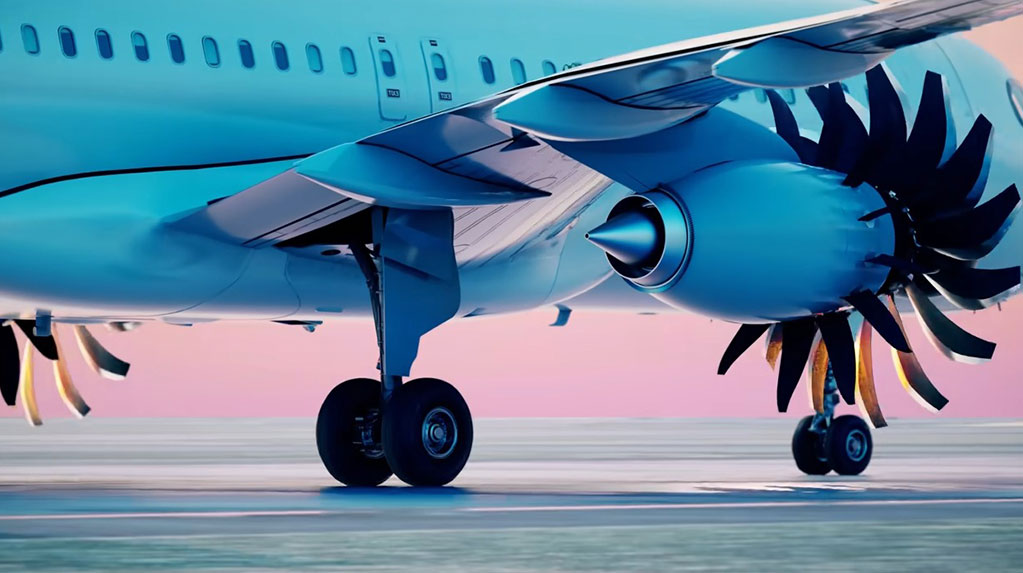
Open Fan is the company’s name for its large, unducted turbofan engine design. Rather than being contained within an enclosed cowl as in traditional turbofan engines, the fan blades are entirely unducted. Safran claims this allows for a larger fan size with less drag, improving durability and fuel efficiency.
While General Electric and Pratt & Whitney evaluated early unducted fans aboard airborne testbeds in the 1980s, they were hampered, in part, by undesirable noise characteristics and concerns about fan blade containment. Safran reports that its “unique supercomputing technologies” enable it to optimize its designs for both aerodynamics and acoustics. Additionally, advancements in composite technology over the past 40+ years are expected to yield similar improvements in efficiency, blade retention, and durability.

To date, Safran reports that preliminary design reviews are complete and that the Open Fan’s low-pressure turbine has been tested for more than 1,000 hours. The company also reports that more than 2,000 cycles of dust ingestion tests have been completed. Combined with the Open Fan’s inherently superior particle extraction, in which sand and particulate matter are ejected from the fan rather than contained within a shroud as with traditional engines, this bodes well for service life, durability, and reliability.

In addition to the Open Fan progress, Safran has launched a hybrid-electric ground testing campaign. Called PHILEAS, it encompasses a full-scale engine demonstrator linked with two electric systems designed for short- and medium-range aircraft platforms. Unlike lab simulations, these are full-scale demonstrators that evaluate the feasibility of electric aviation with and without energy storage.
With over 500 test campaigns and more than 3,000 endurance cycles completed to date, the RISE program is advancing significantly. Perhaps more importantly, it is doing so on or ahead of schedule, setting the stage to bring clean-sheet aircraft designs from concept to reality.
Topics Related To: AVIATION HISTORY
The Spacemobile: NASA’s Secret Weapon for Winning America’s Hearts
The Goodyear Gizmo: A 290-Pound Helicopter, Inflatable Rotors, and Convertiplane Dreams