Gulfstream Patent Suggests Smart, Interactive Thrust Levers for Future Jets
In the quest to continuously improve aviation safety, there is no shortage of technological innovation. Advanced airframe materials, increasingly reliable powerplants, and intelligent collision-avoidance systems all make air travel safer in their own way. But one of the most complex challenges, with some of the most significant potential benefits, is the interface between the pilot and the aircraft.
In this space that focuses strongly on human factors, perfection is a moving target. As new innovations emerge, engineers must determine not just how much new capability they provide, but also whether and how they can make the flight deck simpler and more intuitive.
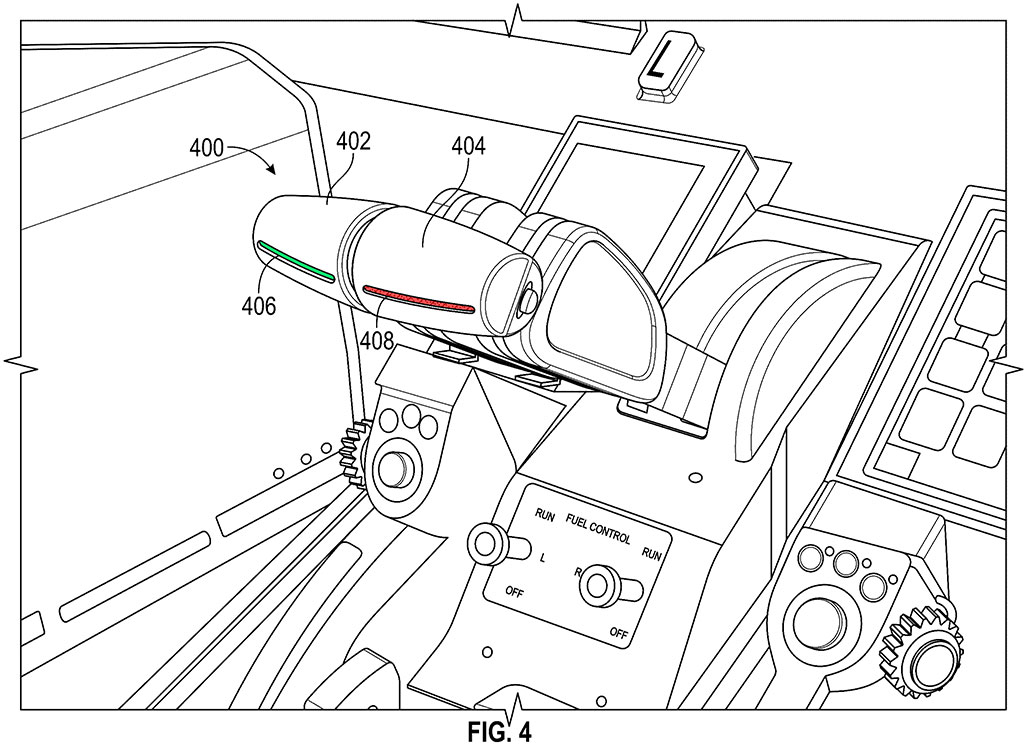
In a pending patent published in June 2025, Gulfstream proposes upgrading basic engine thrust levers to “smart” thrust levers that transform traditionally simple, mechanical levers into an interactive system. Here are three ways that this concept could advance safety by evolving the thrust lever:
INITIAL SMART WINDOW CONCEPTS
Despite consistent, significant improvements in engine reliability introduced over the years, a study by the Aerospace Industries Association (AIA) and the European Association of Aerospace Industries (AECMA) found that pilots continue to make significant errors during powerplant malfunctions. One of the most common errors involves a flight crew responding to an engine failure by misidentifying the problem engine and/or inadvertently shutting down the wrong one.
The study on “Propulsion System Malfunction plus Inappropriate Crew Response” (PSM+ICR) found that 3-5 such incidents occur annually and that the occurrence rate remained constant over a period of 20 years. Given the steady improvement in power plant reliability, this suggests that the rate of inadvertent shutdowns has, in fact, increased over time.
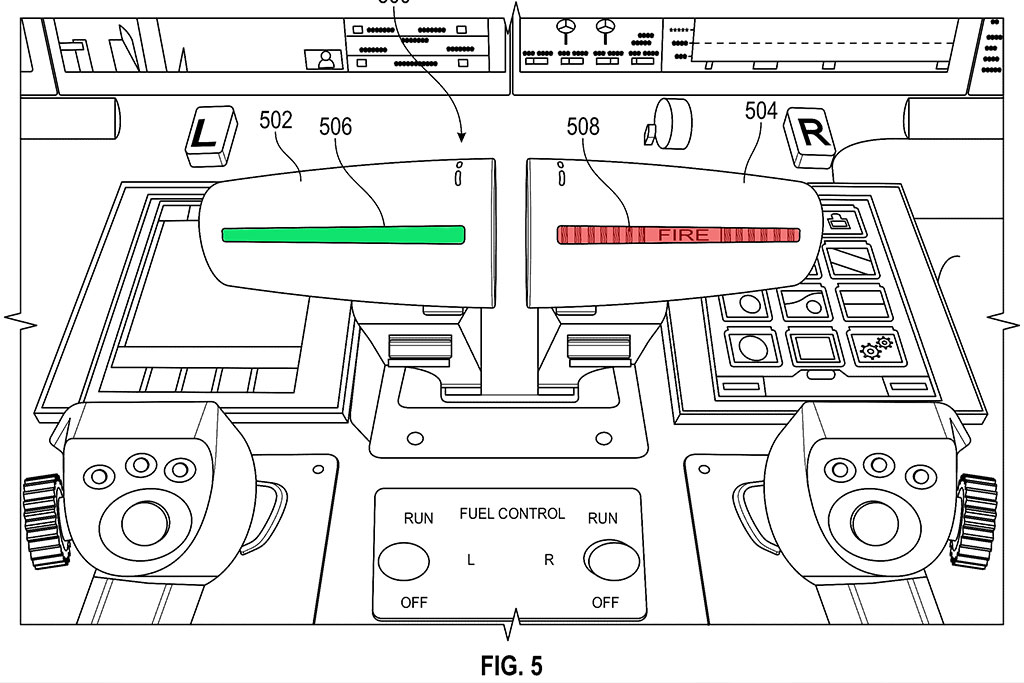
Gulfstream’s patent aims to eliminate the need for a pilot to interpret information during periods of task saturation and high stress. Rather than observing raw engine data on panel-mounted displays, analyzing the situation, and then determining which engine to shut down, a pilot using this new technology would simply look at the thrust levers and react to the one with a flashing red display. This would effectively eliminate a key link in the chain of events leading to inadvertent engine shutdowns.
The benefits wouldn’t be limited to emergency situations. Various colors could indicate modes – for example, green could indicate the autothrottles are engaged, and blue could indicate they are not. Amber could reflect a condition warranting caution but not urgency, such as a temperature or pressure outside of standard limits.
Providing basic visual cues at a glance, without requiring interpretation of raw data, would keep pilots in the loop. And by assigning such cues to an individual thrust lever, the likelihood of a pilot attributing that data to the wrong engine would be reduced.
Haptic Feedback: Minimizing Distractions, Maintaining Focus
During phases of flight that require strong focus on flying the aircraft, such as takeoff, approach, and landing, it is imperative that the pilot flying not be required to divert their attention from flying the aircraft to managing aircraft systems. This level of uninterrupted focus is also key during transitions from flight by reference to the instruments to flight by outside visual reference.
Accordingly, if a flight deck enables a pilot to instantly address a critical issue without breaking this focus, safety is enhanced. And, by integrating haptic feedback such as steady vibrations, pulsing vibrations, knocks, or bumps into smart thrust levers, Gulfstream aims to do precisely that.
In theory, a pilot on final approach with their hand on the thrust levers would become aware of an engine fire when the corresponding thrust lever vibrates. The alert vibration could be steady or pulsing. Instantly, the pilot would be able to positively identify the problem engine and apply initial control inputs without ever having to look away from the flight instruments or the runway.
The flight deck is a working environment where visual focus needs to remain unbroken and in which aural cues, such as callouts from the other crew member and radio calls, take precedence. Transmitting key information via a relatively uncluttered sense, such as touch, could be key to maintaining focus and minimizing distractions during critical phases of flight.
Integrated Controls: Jet Fighter Tech in Civil Aircraft
For decades, tactical military jets have adopted a concept known as HOTAS (Hands On Throttle And Stick). During combat or other phases of flight, combat pilots must keep their hands on the control stick and thrust lever to react and respond as quickly as possible. By placing key controls and buttons onto each hand grip, the pilot no longer has to divert their attention into the cockpit, locate physical buttons, manipulate them, and then return their hands to the controls.
Instead, the HOTAS concept places key buttons and controls directly onto the control stick and thrust lever(s). Commonly, a pilot is able to press various buttons with each individual finger, almost like typing, to activate various modes and perform key functions.
The Gulfstream patent resembles the HOTAS concept by integrating controls that were once separated into the smart thrust levers:
- Reverse thrust, traditionally activated by a separate, smaller lever mounted on each thrust lever, could be engaged by pulling the main thrust lever past idle and through a gated detent. Accordingly, the pilot’s grip would never have to change, and their hand would never have to leave its normal resting place.
- Fuel cutoff, typically controlled through switches separate from the thrust levers, could be integrated in a similar manner, past an additional, more restrictive gated detent.
- Emergency actions, such as activating fire suppression, could be consolidated into a single control on each thrust lever that triggers a predefined emergency response. Rather than having to look up, locate a control on the glareshield or overhead panel, visually isolate a switch, and activate them incrementally as the emergency condition evolves, a pilot could simply press a single button on the thrust lever whose function changes and progresses in concert with the situation.
Such control integration stands to reduce mechanical complexity and reduce weight, all while allowing pilots to respond to time-sensitive alerts more quickly and effectively. When paired with the aforementioned human factors benefits outlined in the thrust lever design, the concept could represent a significant element in the evolution of flight deck design.
Topics Related To: AVIATION HISTORY
LaGuardia Airport, Circa 1941: Home to Luxury Transatlantic Flying Boats
Boeing YC-14 Transport Jet Prototype